
Reviews
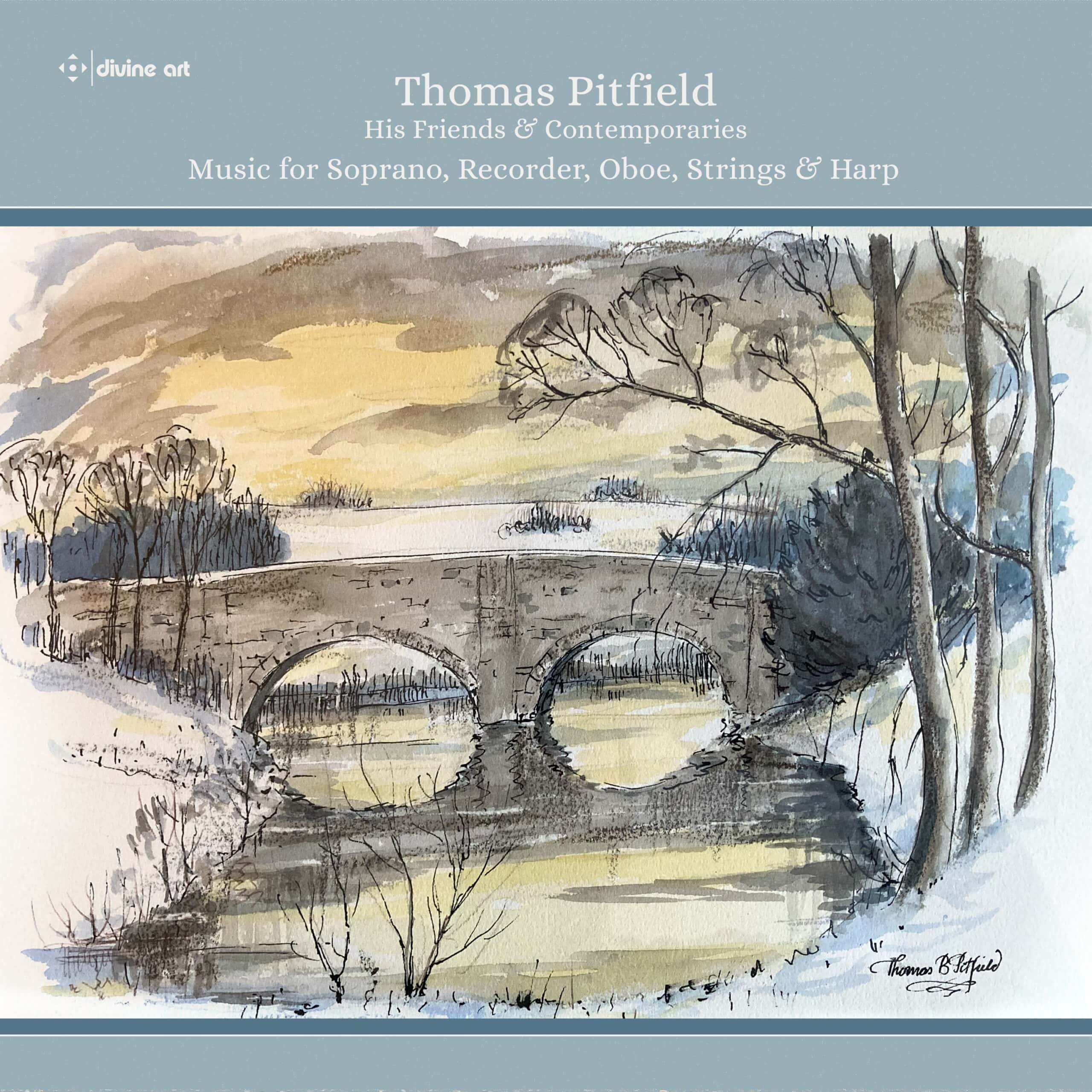
PITFIELD FRIENDS AND CONTEMPORARIES: BMS REVIEW
Here are three discs celebrating the musical accomplishment of Thomas Pitfield and his contemporaries.
Thomas Pitfield (1903–1999) was a largely self-taught as a composer, but he was also an influential teacher, artist, engraver, poet, writer, skilled furniture maker, and ornithologist. He was always writing music for friends, and it is good to hear this music, because it is excellent!
The first item (a two-disc set) juxtaposes Pitfield’s works with those of his contemporaries and friends, and is a delight. The variety of instrumentation is also a boon. Pitfield is represented by his Divertimento for oboe and string trio, first performed by Leon Goossens, his Three Nautical Sketches for recorder and string quartet (arranged by John McCabe) and a Carol Lullaby for soprano recorder and harp. Lesley jane Rogers is the soprano, and she also sings Joubert’s setting of Christina Rossetti’s Remember which he describes as Scena for soprano, recorder and string quartet. This is the composer’s last work and written as a tribute to John Turner in recognition of his support for English composers.
She also performs Now Voyager, a setting of Walt Whitman by the contemporary composer Ernst Hermann Meyer. Meyer escaped Nazi Germany to come first to England and later back to Germany via Switzerland, where this work was written. The two composers never met but had similar socialist outlooks.
The disc has been carefully put together, and three songs by friends of Pitfield for soprano and recorder include works by Nicholas Marshall, Anthony Gilbert, and a winning setting of Blake’s Spring by John Turner, who features throughout the disc. His playing is always immaculate. There are more Blake setting in Three Blake Songs by Stuart Scott, a close friend of Pitfield’s and (like Nicholas Marshall) a pupil of Lennox Berkeley.
Longer works of note are the Fantasy Quartet for oboe and string trio by Moeran, a fine work in the Cobbett fantasia mode, and works by Geoffrey Poole and Richard Pantcheff. Short works by Jeremy Pike, Robin Walker, Gordon Crosse and Christopher Cotton complete the disc.
The disc devoted to Pitfield’s own compositions include the Sonata and Sonatina for his own instrument, the cello, an Epitaph for violin, cello and piano, and his two Piano Trios. Both are in three movements and are strong pieces with a natural feeling for melody, counterpoint, argument and structure. I particularly liked the Debussy-like opening of the first trio, which Pitfield completed in 1930, the lyrical opening of the second movement, and the stirring and heartfelt melodies of the finale. The second trio was completed eleven years later, but there is no record of a performance before the revival of the work in 1983 to celebrate Pitfield’s eightieth birthday. The overall mood is darker and the themes more angular. Both middle movements of these trios begin and end slowly with a middle fast section, and the middle movement of the second trio begins with a long and tortuous piano solo. The finale tries to be cheerful.
The substantial Cello sonata (1938) and the Cello sonatina published six years later are both significant work with something to say. The Sonatina is lighter than the Sonata: the latter has some bold ideas in the opening Variations movement. The third and final movement, although called Epilogue, begins and ends with bravura flourishes.
Everything on these discs is played with loving commitment. The front cover of the booklets of each is a painting By Pitfield of Weaver Bridge at Church Minshull, Cheshire.
REVIEWED BY RONALD CORP

Highways & Byways: Rarities for Recorder
Highways & Byways: Rarities for Recorder by John Turner and company is a treasure trove of late 20th- and early 21st-century main stream pieces for recorder. Over the course of two discs (41 tracks), 20 beautifully sequenced pieces provide a survey of easily approachable, tuneful and substantive works by 15 British composers, one Russian, and one American composer.
Turner recorded this music in May and October, 2023, with the exception of CD2 tracks 14-16, which were recorded in 2008. Turner (b. 1943), plays with virtuosity and utmost musicality throughout, clearly having heightened his musicianship over time. There is a consistent harmonic vocabulary in the works on this album. The tonal/modal underpinning gives the listener satisfying anchor points, and makes it easy to follow the melodic and harmonic excursions. However, this does not mean trite or hidebound reuse of major and minor harmonies.
We hear imaginative use of timbre, occasional flutter-tonguing, striking counterpoint, and a range of approaches to tonal composition. Three works that particularly caught my ear are David Butler’s The Summer Triangle (CD1: 12–14), Christopher Ball’s Homage to Dvořák (CD2: 6) and William Bergsma’s Pastorale and Scherzo, for recorder and two violas (CD2: 10–11). Butler’s work takes inspiration from the triangle of stars Altair, Deneb and Vega, as seen by the composer on summer nights.
Ball’s piece captures the sound of the much loved Czech composer Dvořák in a remarkably concise 4.5 minutes for alto recorder and piano. Bergsma was an American composer who studied with Howard Hanson and taught at Juilliard. In his piece the melodic lines in all three instruments weave together beautifully, as the timbres of violas and alto recorder combine and contrast. One of the shortest and most charming pieces on this album is Dorothy Pilling’s Conversation Piece (CD2: 12).
The least expected work is Russian Alexander Gretchaninov’s Concertino, op. 171 for 2 recorders and piano (CD2: 9), a piece both catchy and cute. The album concludes with David Ellis’ Fipple-Baguette: Three Encores for Solo Recorder, op. 76 (CD2: 14-16), a challenging and complex work with a lovely fade-out ending, and Thomas Pitfield’s A Little Caribbean (CD2: 17) for recorder and piano, rich with fluttering melodic line and 7/8 time signature.
Of the many recordings by John Turner that I have heard, Highways & Byways may be my favorite thus far. The variety within the common elements among the pieces works very well. Not only is Turner’s playing winning, but Stephan Bettaney’s piano playing is nuanced and present in such a way that the pieces strike the ear more as duos rather than solo instrument with accompaniment.
Kudos as well to Laura Robinson (recorder) and violists Catherine Yates and Alex Mitchell. The recorded sound by engineers gives a very satisfying stereo image on the CD, and I imagine the HD 24-bit would be even better. As you listen, please take advantage of Turner’s notes in the booklet. This is an album I would happily give both to fans of 20th-century recorder music, and to those who are skeptical. Thank you, John Turner!
REVIEWED BY TOM BICKLEY
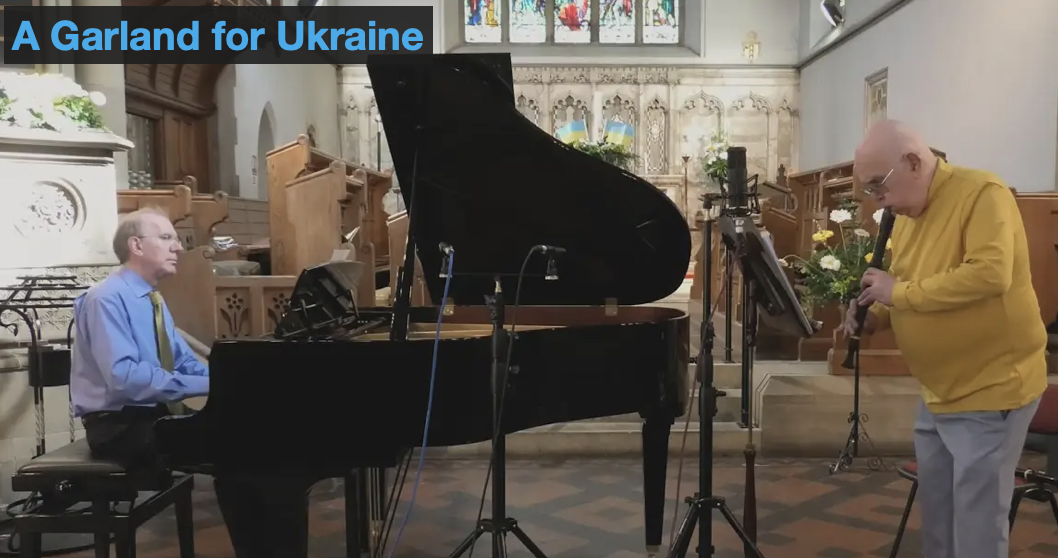
A timely humanitarian project by the English recorder virtuoso and composer John Turner is available via a 26-minute video at British Music Society as well as on Turner’s own website, John Turner – Recorderist. In this project, A Garland for Ukraine, Turner gathers ten short works by ten composers, including Fulvio Caldini and himself, to “show their admiration and support for the Ukranian nation and its brave and delightful people in this their hour of need.” I realize as I write my comments that these words will be published in the autumn of 2022, yet still support will be needed then, no matter the state of the current war there.
Susan Bettaney and Jeremy Pike, playing piano join Turner who plays alto and tenor recorders. A number of the works refer to the Ukrainian national anthem or to Lysenko’s Prayer for Ukraine. While overall the affect of the works is one of determination, there is a range of emotions expressed, and the collection embraces mourning and melancholy but also deeply rooted hopefulness. Recorded in St. Paul’s Church, Heaton Moor, Stockport, UK on 21 April, the audio quality is very listenable (even if not to the highest studio standards), and it is good to see Turner, Bettaney, and Pike in the video. All of the pieces are lyrical and thoroughly accessible. In the video, each is preceded by a line of text about the work. Turner’s A Sad Pavane for Ukraine evokes effectively Thomas Tomkin’s 17th century work A Sad Paven for these Distracted Times. Jacob Fitzgerald’s Prayer ends in a lovely touch of the final recorder note resonating in the piano strings. Jeremy Pike’s Elegy uses the alto recorder for the vigorous center section, framed by more contemplative writing for tenor recorder. American Carson Cooman’s Hollow places the piano and recorder in a sort of call and response mode throughout. In Robert Matthew-Walker’s Orationem Brevem ad Pacem the composer weaves together the familiar Ode to Joy melody with the Ukrainian national anthem. Sasha Johnson Manning’s haunting Prayer for Ukraine opens and closes the video.
Viewers of this video are encouraged to contribute to the Disasters Emergency Committee for the Ukraine Humanitarian Appeal (https://www.dec.org.uk/appeal/ukraine-humanitarian-appeal) or to any charity assisting Ukrainians. Specifically mentioned is the Razumovsky Trust (https://razumovsky.co.uk/events/event/help-ukraine-fundraising-concert-and-dinner), which is Ukranian cellist Oleg Kogan’s effort to support Ukranian musicians.
John Turner and all involved in this worthy project deserve our gratitude and respect, and the cause our support.
-Tom Bickley, Recording Reviews Editor, The American Recorder Magazine

This fine disc is a tribute to the late Sir John Manduell (1928-2017), founding principal of theRoyal Northern College of Music in Manchester and widely acknowledged Renaissance Man. It is a sequel to Songs for Sir John, also on Divine Art.
The Aria for Sir John by Adam Gorb (b. 1958) is beautiful; soft strings (the excellent Victoria String Quartet) create a bed of sound over which the insuppressible John Turner weaves recorder lines. It is the recorder that “sings” the aria, with strings an active conversation partner. Premiered in 2019 at the University of Manchester, the work is airy and free. It’s no surprise to learn from James V. Maiello’s review of Gorb’s First Symphony that that work is “more like a divertimento than a symphony” (Fanfare 40:4); there is a deft hand at work here.
The Gorb acts as an introduction to music by Manduell himself. First, there comes the eight-minute Elegy for string quartet of 2005. It is dedicated to Christopher Rowland (first violin of the Fitzwilliam String Quartet and a teacher at the Royal Northern). It is a highly impressive piece, firstly for its expressivity but also for its clear, tight pitch organization and equally clear counterpoint. The various aspects combine to create a most moving piece. The string orchestra version (not heard here) was requested and premiered by Kent Nagano, whose thoughts on the piece seem prescient: “I found the work to be a masterpiece—one of Sir John’s best. A work firmly anchored in the future yet written in a way that one heard the past—one recognizes the universality of humanism.” Those words about the future ring true in the grittiness of some of the chords, almost rasping in this performance.
The texture thins for Recitative and Aria, performed here by Benedict Holland and Kim Becker. It was written in memory of Peter Crossley-Holland (a colleague of Manduell’s at the BBC), and Manduell used the two salient letters of the dedicatee’s surname as a starting point. The mode of expression is simpler than in the Elegy, the 11/8 “Aria” dances and skips rather than confuses. This is a sterling performance; tuning (no doubt problematic in some of the writing) is superb throughout, and the recording is perfectly balanced.
One of Manduell’s earliest works, the charming Trois Chansons de la Renaissance dates from 1956, when he was a student of Lennox Berkeley at the Royal Academy of Music in London. It’s probably no accident that Lennox’s own first published work was a setting of the same du Bellay poem that comprises the second movement. But first there comes an utterly compelling and delightful setting of some Ronsard, “Mignonne, allons voir si la rose” (texts are included, but not translations—not relevant in the case of the Alwyn, of course). The second is that du Bellay setting of “D’un vanneur de blé aux vents.” It is here that soprano Rachel Speirs comes into her own, teasingly playful, her light soprano perfect for the fragranced music, invoking late-summer haze as a thresher gets on with his work. Finally, we have “A sa dame malade,” a setting of Marot (which, like the Ronsard, begins with an invocation of “Mignonne”). There is wit in this last setting, which is about the dangers of “gastronomic self-indulgence”; perhaps I need to listen to this on repeat.
Using treble and descant recorders, John Turner gives a compelling account of Bell Birds from Nelson, written for the 70th birthday of composer Anthony Gilbert. I confess, with all of the Manchester-centric music, I had imagined Nelson to be the place in Lancashire (in the borough of Pendle); but no, this one is in New Zealand (Gilbert was an Ozophile). The programming, like Turner’s playing, is perfect; the single line ending of Bell Birds from Nelson segues into the solo clarinet which opens Nocturne and Scherzo (for clarinet and string trio), premiered in 1968. It is Manduell’s harmonic awareness that is so striking here; the construction of the chords is managed by a super-acute ear. While the reference to Bartók Night Music for the Nocturne stands, it is slightly misleading in that Manduell’s vocabulary is absolutely distinct from Bartók’s (and, possibly a rather controversial statement, arguably preferable). The lead-in to the Scherzo is delicious, a lovely clarinet slide that is to return later (beautifully managed, as are the angularities of Manduell’s writing in the Scherzo proper). There is beauty everywhere in this piece; compositionally, certainly, but particularly also in Linda Merrick’s simply gorgeous sound and phrasing, and her complete comprehension of what Manduell wanted. The final Manduell piece is a playful work for recorder and piano, Tom s Twinkle, brief and to the point, described by the composer as a “short jeu d’esprit.” It was written in memory of the composer Thomas Pitfield (lecturer at what was then the Royal Manchester School of Music). Choosing 11/8 for Tom’s Twinkle was in itself a homage to Pitfield’s penchant for such irregular time signatures.
Far grittier is Michael Berkeley’s A Dark Waltz for recorder and string quartet, dedicated to Manduell’s memory. It is in essence a “Valse triste,” originally for recorder and string quartet (as it is heard here); there is another version are for oboe and string quartet. It is intriguing how the waltz morphs into a shadowy processional; it’s a mini-masterpiece. Turner’s solos are compelling, as is the interaction of recorder with string quartet. Superb chamber music playing is on offer here from Turner and the Victoria String Quartet.
It is William Blake who provides the texts for five of Alwyn’s songs from “Songs of Innocence.” It was written in 1931, and the writing is charming and deft; we hear five of the 12 songs in a realization by David Matthews, himself a noted composer. Alwyn taught Manduell composition for two years at the Royal Academy. In the fresh tenderness of these songs one can see why Manduell admired Alwyn so much. Speirs again excels, while the ear is often drawn to the gossamer textures of the Victoria String Quartet; Phil Hardman’s recording (produced by Paul Hindmarsh) allows all detail to flower. The final song, “Nurse’s Song,” is particularly effective, an invitation for children to come in from play as the sun is setting (and their reluctance to do so).
Another Renaissance Man, Richard Stoker (1938-2021), another Lennox Berkeley pupil and friend of Manduell, offers Memento Mary Magdalene, a piece for recorder and string quartet that is an offshoot from his activities as an actor in the filming of The Da Vinci Code (2005). This is a lament for Mary Magdalene, and it is marked religioso. It is incredibly powerful, and certainly acts as an invitation to investigate more of Stoker’s music. There are only two reviews of Stoker’s music on the Fanfare Archive, and at least one of them is problematic as the disc is now so old it might be hard to find. Reviewed in Fanfare 2:3 (Jan/Feb 1979), Stoker’s three string quartets and a Miniature String Trio were played by the Strange Quartet, music which reviewer Lewis Foreman found “Bergian” (not something I hear in the Memento, particularly); Stoker’s op. 5 Sonatina for Clarinet and Piano was played by Einar Johansson and Philip Jenkins on a mixed clarinet and piano disc on Chandos (Fanfare 16:3, a piece rather dismissed by John Bauman as “hardly great music”).
There is much variety on this disc, and much to be treasured. Extensive notes seal the deal.
Recommended.
Colin Clarke (Fanfare)
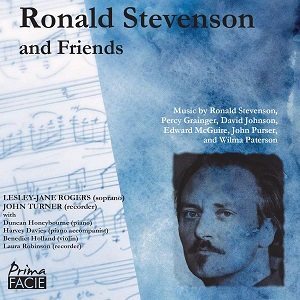
Ronald Stevenson and Friends
Ronald Stevenson was one of the great 20th century pianist/composers who trod a path between modernism and folk traditions. This disc showcases him and his friends in music who shared his ideas and beliefs, among whom was the distinguished composer and pianist Percy Grainger. His best-known work, Passacaglia on DSCH, is dedicated to Shostakovich; he presented the score to the Soviet composer when he visited Edinburgh. The work has been recorded by John Ogdon, Raymond Clarke, James Willshire, Igor Levit, and, most importantly, in a legendary recording, Stevenson himself.
Born in Blackburn in England – both parents had Celtic origins – Stevenson moved to Scotland in the fifties and made his home there until his death. He was inspired by a long line of great pianist/composers – Paderewski, Liszt, Busoni, Sorabji and Grainger – and wrote a huge number of compositions, including 500 songs, several concertos, works for the piano and for chamber groups. He never sought fame or publicity, preferring the peace and solitude of West Linton in the Borders, which served as a sanctuary from the stress of the big city.
Many pieces on this album are no more than a minute or two in length but each gives us a delightful insight into Stevenson’s world, typical of which are the opening set of songs A Year Owre Young and To Autumn, sung beautifully by lyric soprano Lesley-Jane Rogers accompanied by Benedict Holland on the violin. Stevenson’s settings of Blake’s Poetical Sketches ‘To Autumn’ are performed by John Turner on the solo recorder catching the luxuriant harmonies of the score, and Turner is the performer singing the Celtic Triptych most charmingly in the Strathspey and the Twelve-note jig (Giga dodecafonical).
A Wee Holiday Suite for recorder and piano summons up amusing images in Ulla and Ella’s Veranda-Hike, which describe the daily chore of walking his daughter Ella around the veranda of the Grainger home, while other sections make fun of Bipo’s movements in Bipo’s Dance, Bipo’s sleepo, and Bipo’s ear-pop (Bipo was Stevenson’s nickname, invoking the Marx Brothers, for his then publisher Barry Peter Ould). The final movement, A Balow for a Balough, commemorates Teresa Balough, who catalogued his compositions. It is difficult not to burst out laughing as Turner and Harvey Davies bring out all the humour of these miniatures.
Stevenson’s harmonies, poignant in their ephemeral intimacy, are shared in Wilma Paterson’s set of five Little Cynical Songs, touchingly sung by Rogers in Nostalgia for Sweet Friendship, and most affectionately in The Little Goddess Pan from texts by Joan Ure. The songs were written for a play by Ure staged at Glasgow University, since when Paterson has added to her musical talents by writing novels. John Purser is a composer, poet and the author of the monograph Erik Chisholm, Scottish Modernist and the award-winning Scotland’s Music. He has composed in diverse genres, including opera and the solo lute. Now domiciled on Skye, he presents an image in his Skye Blue of the remote and starkly beautiful island, vibrantly suggestive here of the piobairreachd Highland bagpipes and vividly performed by Turner on the solo recorder.
At the heart of this album are three of the Twelve Preludes and Fugues written for Stevenson by David Johnson. He was a uniquely gifted composer who never achieved recognition in his career. He was also a musicologist who researched the music of Thomas Erskine, the Earl of Kelly, and authored several books on Scottish music of the eighteenth century. Among his compositions are four operas, a cantata and several concertos, including several pieces for the trumpeter John Wallace. Johnson’s set of Preludes and Fugues are on the four note motif B (B flat), H (B natural), E, A, transposed from the Gaelic bheatha, which means life, welcome, livelihood and food.
The Fugue for Prelude No. 1 in B flat pays homage to Bach, yet has un-Bachian blue notes mixing major and minor modes. Prelude No. 6 in G is a transcription from Stevenson’s song based on Hugh MacDiarmid’s O Jesu Parvule that invokes the image of the Madonna and Child. The Fugue is partly based on a German chorale, while Prelude No 8 in F is a parody of a seventeenth century psalm, and the Fugue is a comic invocation of English holidaymakers at the seaside. Like Stevenson, Johnson writes tongue-in-cheek. They are masterfully performed by Duncan Honeybourne.
Stevenson’s Three Improvisations on Themes by Emanuel Moor for the solo recorder were composed for ‘my South African friend Katherine Moor, maîtresse des poupées, the niece of Emanuel Moor’. She was the niece of one of Busoni’s pupils, whom Stevenson befriended when teaching at Cape Town in the 1960s, and is sympathetically portrayed here by Turner. Stevenson’s Two songs to poems by William Soutar are from a volume of fourteen songs, the first of which, Hallowe’en Sang,is lightly humorous: ‘Dinna gang oot the night: dinna gang oot the nicht…’ while The Quiet Comes In is touching in its effortlessness and performed with great sensitivity by Rogers and Turner.
David Betteridge’s poem Not to be Hushed (in memory of Ronald Stevenson) inspired Eddie McGuire’s Prelude 29 (from his set of 24 preludes written for every instrument), which McGuire writes in his note are about ‘learning about the idiom and soul of each instrument in the process.’ This is a stylishly attractive piece by McGuire – the latest composition on this disc – voiced sensitively by John Turner.
Stevenson’s arrangement of Over the Hills and Far Away was written at White Plains when he visited Ella Grainger on her 89th birthday and dedicated to his then publisher and friend Barry Peter Ould. To bring this CD to a fitting close is Percy Grainger’s Country Gardens in his second arrangement for two descant recorders performed by John Turner and Laura Robinson.
The recordings are outstanding in capturing every nuance of the songs and solo pieces, and clearly heard as if we were in the first row of seats in the concert hall. A 16-page booklet with English texts gives details about each work and full texts of the songs and poems (with transliterations from the Scots into English) and of the composers and performers.
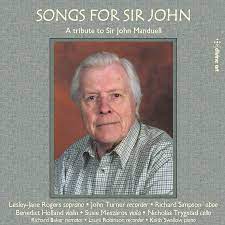
On Songs for Sir John we have the pleasure of hearing British recorder virtuoso John Turner on all 22 tracks of this CD. The compilation comprises works composed in honour of the composer, teacher and arts administrator Sir John Manduell (1928-2017), though none of his works appear here. Fortunately Mandell’s work is available , though not widely known in the U.S.
Mandell met Turner when there was a need for a recorder teacher at the Royal Northern College of Music, of which Madell was principal. Their long friendship yielded a number of works written for Turner. From Manduell’s works employing recorder, I recommend Brief Encounter, and Fountain on Ca the Yowers, (both recordings by John Turner and the Manchester Sinfonia).
Manduell was a composition student of Lennox Berkeley (1903-89), Berkeley’s lineage includes studying with the renowned Nadia Boulanger in Paris, France, plus significant influence from Igor Stravinsky and Francis Poulenc). The strong lyrically model vocabulary of British composers such as Benjamin Brittan (1913-76) and Ralph Vaughan Williams (1872-1958) is quite present in Mandell’s works.
The 16 pieces by 16 composers on this CD show the further blossoming of that lineage – not as a uniform approach, but in related use of melody, rhythm and timbre, and in the presence of Turner’s marvellous playing. One work, Robin Walker’s Four Nursery Rhymes, is a reissue from 2005. The others were recorded in December 2019 for this disc.
Likely the most familiar (to Americans) among these composers are Sally Beamish (born 1956) and Berkeley. Beamish’s elegant Yeats Interlude (track 5) is for soprano and alto recorder (one player), oboe, violin and cello, and dates from 2018. It is among the eight works based on W.B. Yeats’s poetry that open the CD.
Particularly charming are the Three Duets for two recorders (tracks 13-15) from 1938, 1924 and 1955 by Berkeley, edited by his son, composer Michael Berkeley. Laura Robinson joins Turner ably on these duets to create a wonderful duo ensemble sound.On the majority of works on this disc we hear soprano Lesley-Jane Rogers’s beautiful singing, in which the texts are clearly audible.
Perhaps my personal favourite piece on Songs for Sir John in Jeremy Pike’s 2018 setting of Yeats’s poem The Cat and the Moon, for soprano, alto recorder, oboe,violin and cello.
The recordings from 2005 and 2019 sound great on CD. That is the format I recommend, not only for the audio quality, but for the excellent commentary by the composers and performers provided in the booklet. Once again, Turner and colleagues provide a wonderful collection of music in which the recorder figures prominently. I look forward to more!
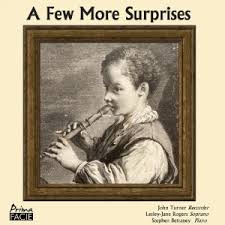
A Few More Surprises
John Turner, Lesley-Jane Rogers, Stephen Bettany
Prima Facie PFCD246
Our member John Turner, the doyen of British recorder players (or, as he would say, recorderists), presents here an intriguing compilation of 20 short works, all of them new to me. The recorder (sopranino, descant or treble) is in all of these, sometimes alone, sometimes with the soprano Lesley-Jane Rogers, and sometimes with the pianist Stephen Bettany, but never with all three. Members may recall the Rainsongs CD of works by Karel Janovický made with Dvořák Society support in 2016 which also featured John and Lesley-Jane and was reviewed in Newsletter 121, October 2017.
Here there are works by 16 different composers, all but one of them British and most writing within the last 50 years; they include Lesley-Jane’s Deux Bouches, an attractive vocalise for soprano and treble recorder written for John’s 80 birthday celebration, and John’s own Wedding Notes for solo recorder, a witty and cheerful set of variations on Wagner’s Wedding March written for the marriage of friends last year.
The other British composers are Anthony Hedges, Howard Ferguson, Robin Stevens, David Blake, Stephen Banfield, Douglas Steele, John Stanley (edited and arranged by Gerald Finzi), Peter Dickinson, John Golland, Matyas Seiber (Hungarian by birth, but later a British citizen), Max Paddison, Michael Baron and Gerald Hendrie. The ample notes provide information on all these, with many of whom John Tumer has or had a personal connection.
The works span a remarkable range of contemporary recorder music. All receive strong and well-recorded performances, though one would probably not want to listen to the whole CD at one sitting. Items I particularly like include Variations on Bobby Shofio (Stevens), Capriccio and Three Minis (Banfield), Homage to Poulenc (Dickinson), Pastorale (Seiber) and Cassouler Rog (Hendrie).
The single non-British composer represented is likely to be the one of most interest to our members: Vislava Kapelová. Among the manuscripes found after her early death were two of a proposed set of three short pieces for descant recorder and piano. Tales of a Small Flute (Povidky malé fémy), intended, it is believed, for her husband Jiti Mucha, who played the recorder, and here recorded for the first time. These tiny compositions last November 2025 less than two minutes in total, but their beautiful simplicity makes an immediate impact. How tragic that she did not survive to write more.
Terry Heard
A Few More Surprises
Source: PROPERMUSIC
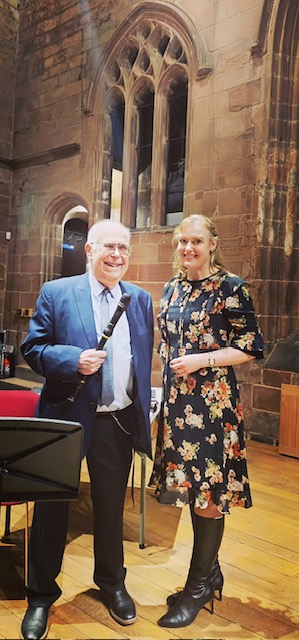
CARLISLE MUSIC SOCIETY 14th November 2024
We were treated to a master class of musicianship by three very experienced and talented musicians, all extremely well known in their specialist fields. A large and very appreciative audience sat spellbound as John Turner (recorder), Richard Simpson (oboe) and Janet Simpson (piano) ranged from the 18th century music of Telemann and Handel to the 20th century works of Benjamin Britten, Michael Head and others, including folk and jazz elements.
However, the centre piece of the whole concert was a world premiere performance of a specially composed work by Helen Leach for recorder, oboe and piano. “Hill Top” was written as a homage to Beatrix Potter. Although short (about four minutes), it captured perfectly the sweeping landscapes of the Lake District and allowed each of the instruments to contribute to create the visual images we were encouraged to see. This work deserves to have a lot more performances! Adding to the interest was the fact that the composer, Helen, was present and talked about the commission and what she was trying to convey.
John Turner has had a long career popularising the recorder, from the days of David Munroe’s Early Music Consort to performing modern pieces, sometimes commissioned by him. He showed superb technical mastery on a range of recorders, and especially memorable was “Skye Blue” for solo recorder by John Purser when evoking a Scottish background.
Richard Simpson also has had a distinguished career as Principal Oboe in the Halle and in the BBC Symphony Orchestra, as well as being equally at home in many chamber music activities. His mellifluous tone on the oboe was admired by all who have tried to play the instrument. He was equally at home in Telemann and Handel as with Benjamin Britten’s challenging “Metamorphoses after Ovid” depicting six Greek gods.
And we must not forget the pianist! Janet Simpson has enjoyed an illustrious career accompanying and performing as soloist. She had a demanding role and her accompanying always showed a sympathetic awareness of style and technical ability.
So – the concert was a huge success . The organisers should be congratulated on this and the two previous concerts this autumn. The next concert is on Thursday 23rd January with a violin and piano recital.
Highways and Byways: Rarities for Recorder
John Turner (recorder)
Stephen Bettaney (piano), Laura Robinson (recorder), Catherine Yates (viola), Alex Mitchell (viola)
rec. 2023, St. Elizabeth’s Church, Ashley, UK
Divine Art DDX21245 [2 CDs: 105]
John Turner, now in his early 80s, keeps recording rare and little-known works by rarely heard or little-known composers. His rate of learning is phenomenal, and his tone quality and virtuosity still shine through. He is a giant in the recorder world, as this twofer clearly demonstrates.
Some of the fourteen composers here can be strongly associated with John Turner, like David Ellis, John McCabe and Thomas Pitfield, who may have been or were his personal friends. Ellis worked for a while at the BBC. His Three Encores for solo recorder are challenging and exciting. The attractive Mount Street Blues, dedicated to his friend McCabe, refers to the street in Liverpool where McCabe spent his early youth.
Pitfield is represented by two miniatures. Dancery – a title borrowed from the renaissance composer Tielman Susato – is a set of tuneful dances. Pitfield’s ability to write an earworm shows too in A Little Caribbean, which spends much time in 7/8.
There are McCabe’s two brief pieces here, in an unusually sunny mood. He wrote Sam’s Tune for a Granada TV series in 1973. Domestic Life is an arrangement of ‘three tunes from an entertainment originally for voices in ensemble from 1969’.
The album kicks off with Lennox Berkeley’s three-movement Sonatina, a joyous performance of a joyous work. The longest work on the first disc David Butler’s Summer Triangle. Butler explains that these are Altair, Deneb and Vega, three stars in a constellation seen especially in the summer months. As he wandered Suffolk beaches, he was struck by the magic of the scene and by the rising moon, but this is not necessarily Romantic nature music. There is atmosphere and vitality, and some dissonance, all under the umbrella of arresting ideas and melodies. That is quite a highlight. The box cover shows the night sky which inspired the work.
John Turner himself is no mean composer, with many choral works in his catalogue, for instance. He wrote The Sad Pavane in 2022 for a video made in support of the Ukrainian people. There follows the brief and jazzy Hopscotch from 2012. In a way, this sums up the album: beautifully crafted, idiomatically conceived music, largely undemanding and tuneful. Needless to say, it is played immaculately and expressively, accompanied by the supportive and sensitive stalwart Stephen Bettaney.
It may be difficult to find originality in some of the numbers here. Christopher Ball’s A Cheerful Little Piece and Homage to Dvořák have nothing especially interesting to say. I feel the same about Dorothy Pilling’s all-too-brief Conversation Piece.
Two viola players add interest. They join Turner in Pastorale and Scherzo by William Bergsma. The unusual combination gives a lovely warm sound, with the tenor recorder in the Pastorale and the treble recorder in the light-footed Scherzo. There is good fun in two pieces associated with the village of Edgeley in Cheshire close to John Turner’ s home in Stockport. Peter Hope’s The Edgeley Tram has suitable sound effects. David Jepson’s Edgeley Fold, his last work, was a present for Hope’s 80th birthday. Jepson was born in Edgeley, and Hope lived there as a child.
Peter Pope contributes a very English Sonatina of 1980. He was a pupil of John Ireland. Something of his teacher’s character appears especially in the slow movement.
It was a surprise to find Stravinsky and Gretchaninov in this programme. The former’s Lullaby for two recorders is an arrangement of ‘Ann’s Lullaby’ from The Rake’s Progress. The latter’s Concertino includes a second recorder, and has a folk-dance element with the instruments often in thirds.
We also have music by the all-too-little heard Wilfred Heaton and John Locke. Heaton’s Little Suite is especially pleasing. Its five movements have a Hindemithian quality in their harmonies. The cantabile is a good example of his originality.
Another Sonatina is by John Locke. He composed it in 1978 for tenor recorder. John Turner plays the first two movements on that instrument, but the finale works better, it is thought, on the descant. The language is quite chromatic and original, but it is not always possible to find its melodic direction.
All told, the entirely admirable project offers us an opportunity to discover music and composers who have largely gone under the radar. John Turner, aided brilliantly by Stephen Bettaney, has again done us all a great service.
Gary Higginson
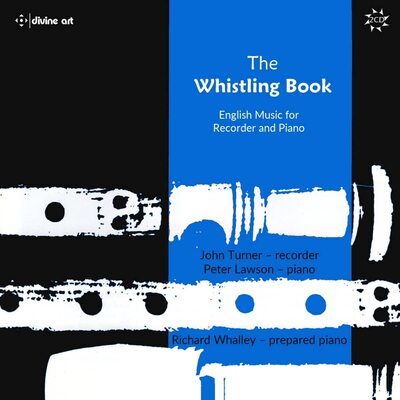
Many of the tracks on this disc originated, I believe, from a compact disc from Forsyth Brothers, a musical instrument and sheet music shop on Manchester’s Deansgate with a long and venerable history. Forsyths holds many fond memories for me, as I was brought up in Manchester and this was my go-to shop. Many years later, I returned to write on their piano stock for a UK journal. This rerelease, then, is a testament to their devotion to and passion for music. It is also testament to John Turner, whose work for the recorder has helped to put contemporary English music for the instrument on the map.
We met the combination of John Turner and composer Nicholas Marshall on a disc entitled Anthony Burgess: The Man and his Music on Métier (Fanfare 37:4, reviewed by myself back in 2014). Now we have a whole two discs of contemporary recorder music, a veritable treasure trove for recorder players. Take Geoffrey Poole’s attractive Skally Skarekrow’s Book, comprising a nicely varied four movements, from the pastoral “Clouds (with silver linings)” to the light waltz “Spring Breezes” (where Peter Lawson gets his moment of glory in the rhythmically skipping Trio). After one 1:19 of languishing in the sun (“Sunshine” is the title of the third movement), the final “Hailstones” delivers a helter-skelter shower of notes. It’s great fun, but amongst all the frivolity is a piece that requires keen communication between the players. Rhythms and motivic interchanges need to be pinpoint; and, indeed, they are everywhere on this release.
The musical language of Mancunian composer Michael Ball’s Prospero’s Music is more advanced. Ball studied with Howells at the Royal College of Music and later, in Siena, with Franco Donatoni. Unafraid to call for extended techniques in Prospero’s Music (originally for recorder and guitar), Ball’s 1984 piece is inspired by The Tempest; the sound of a sea-buoy in the mist on a coastal walk provided the necessary nudge of inspiration. Some of the rhythms are taken from speech rhythms in “Full Fathom Five” (Ariel). There is a scherzo for Ariel, and music depicting the lovers Ferdinand and Miranda. A piano cadenza (with “recorder taunts”) is stunningly delivered by Lawson. While Poole’s piece was the perfect opener, it is good to hear something one can get one’s teeth into. Again, ensemble is impeccable, and there is a wonderful sense of play from Turner, who is also clearly a consummate master of the recorder. The piece is just a smidge under 10 minutes, but my only complaint is that there is not more of it. The ending, though, is beautiful and haunting.
The programming is carefully considered. Light relief is required after Ball’s piece, and Alan Bullard (b. 1947) does the honors with his Recipes, five delightful movements that encompass “Prawn Paella,” “Fish and Chips,” “Special Chop-Suey,” “Coffee and Croissants,” and “Barbecue Blues (when the fire goes out).” As frothy as the presumed cappuccino of the initial “Coffee and Croissants,” this is skillfully written, as is the Gallic-tinged Waltz. The barbecue is clearly a laid-back affair (there is some amusing flutter-tonguing from Turner here). Continuing the national affiliations, “Prawn Paella” arrives as a habanera with a Carmen quote, while there is inevitable pentatonicism in “Special Chop Suey” (an air of mystery does make me wonder what went into the mix, though). The UK’s second national dish, fish and chips (we are told the first is curry) is a circus galop, cheeky and outrageous. It needs a nimble player, and Turner is obviously one such.
Lancashire-born Alan Rawsthorne is probably the most familiar name so far, another Northerner (born in Haslingden, Lancashire in 1905). His Suite was premiered in 1939 and later arranged for viola d’amore and piano. Thought to be lost, Rawsthorne’s Suite resurfaced in 1992, in the viola d’amore version. But the alterations from the recorder version were apparent, and we are blessed to hear a sophisticated piece, particularly its second movement “Fantasia.” Even the concluding “Jig” is no mere vapid romp. This is a fabulous piece.
Born in 1942, Nicholas Marshall taught at Dartington; he also penned two operas. His Caprice is all too brief, but it does breathe the air of carefree contentedness. Against that, Douglas Steele (1910–1999, a successful conductor as well as composer) offers a haunting Song for recorder and piano. It is no surprise to learn this was originally a song for voice and piano. The piece seems to offer solace, ending in distinctly warm mode.
Surrey-born John Addison (1923–1998) is probably best known as a composer of film and television music. Here, we have his Spring Dances, premiered by Turner in 1995. Written for solo recorder, the second of the three movements, an Andante con moto, is rather bland, but the outer movements have more life. Interestingly, Addison’s Wellington Suite has just recently turned up in Fanfare’s reviews (British Piano Concertos on Lyrita, reviewed by Robert Markow in 46:3, Jan/Feb 2023). From the review description, Wellington Suite sounds like a lot of fun; I find it hard to find such joy in Spring Dances, no matter what that title promises, alas.
The music of Robin Walker tends to fuse the traditions of English music with those of India (especially the rhythmic processes of the latter territory). First performed in York Minster by John Turner and the composer, A Book of Song and Dance comprises 11 movements. There’s no missing the composer’ dipping into the repository of English folk music. The fifth movement, “Rite,” is particularly fine, with the spiky piano lines often in contrast to the more lyrical recorder. Just as impressive is Turner’s tuning: When asked to replicate a (very) high piano pitch, Turner is spot-on. Five of the movements include piano; four are for solo recorder; the remaining two are for solo piano (the 20-second, Bartók-brutal “Dance 1” and a short canon that sits next to it). Just as impressive is “Shenandoah,” the familiar tune garlanded by beautiful, dissonant harmonies on piano. Walker’s writing for piano is incredibly imaginative, and very subtle. He has humor, too (witness the final lullaby, “Tired Boy”; you will recognize the tune, beyond doubt).
The final piece on disc one is also by Robin Walker: Her Rapture (2021), written to celebrate composer and teacher Dorothy Pilling. Walker met Pilling only once, and was impressed by an “idiosyncratic charm that seemed to belong to an earlier age.” Later, he found that Pilling was born near his own hometown of Todmorden (in the West Riding of Yorkshire). As he puts it, “the piece … seeks to set down both the delight and the propriety of this remarkable lady.” Scored for solo recorder, it consists of soaring lines and high, exultant gestures. A whole disc of Robin Walker’s works can also be found on Métier, again featuring John Turner in a couple of pieces. This disc was extensively reviewed by David DeBoor Canfield in Fanfare 43:2, who wrote that “the music of Robin Walker is engaging and effectively written, and will provide enjoyment to anyone who will give a listen.” I can only concur.
The second, shorter, disc reveals a similarly eclectic mix of composers, including a piece by Turner himself. Walter Leigh’s Air for recorder and piano acts as an intrada. After studies at Cambridge, Leigh (1905–1942) studied with Hindemith in Berlin. The short Air is his last work (he was killed four days later, serving in World War II as a radio operator in Cairo; his tank received a direct hit). There is, I think, a touch of Hindemith to some of the harmonies here.
Readers may know I am something of a fan of the music of the long-lived Arnold Cooke (1906–2005). Another Hindemith student in Berlin, Cooke left a large corpus of works, including two operas. The Capriccio for recorder and piano (1985) exhibits the spiky playfulness I associate with his music, and his ability to create lyrical spaces utilizing similar harmonies, often with little or no drop in tempo.
Another UK composer with a fascination for Indian music, Anthony Gilbert (b. 1934), has a particular love of the sopranino recorder. His Farings is a set of eight virtuoso pieces (try the unstoppable second, “Eighty for William Alwyn”). Written over a span of some 13 years, the set nevertheless coheres beautifully, and yet each movement is entirely individual. Try contrasting that “Eighty for William Alwyn” with the very next “Arbor Avium Canentium”; the latter is both a tree of singing birds and variations on the initials of composer Arnold Cooke, whom Gilbert refers to as “the gentlest of composers.” I like the concept of the fifth movement, “Slow down after fifty,” partly because maybe that’s what I should have done (but didn’t) and partly for its surely Messiaen-influenced lines and rhythms. A “great lady of Manchester,” Ida Carroll, is the inspiration for “Ida Carroll Her Lullabye”; the title surely is inspired by Dowland and his contemporaries, and the material by the tuning of Carroll’s double bass (apparently called Ebenezer). Gilbert’s playfulness (although never frothy frivolity) is found again in “MidWales Lightwhistle Automatic,” inspired by the shipping forecast (something of an unexplained institution in the United Kingdom; perhaps there is something reassuring about the announcer’s delivery). Finally, “Chant-au-Clair,” for composer David Cox, reflects Cox’s love of plainchant, but in the most skipping way possible. This is a fabulous set of pieces.
The one piece written by Turner himself here is the Four Diversions. There is a full disc of Turner’s music reviewed on the Fanfare Archive, Christmas Card Carols, again on the Divine Art label (regarding which Henry Fogel gave very positive his thoughts in Fanfare 41:4). The Diversions were written in 1968–69 and comprise “Intrada,” “Waltz,” “Aubade,” and “Hornpipe.” Needless to say, all the movements are superbly written for the recorder. The “Hornpipe” is particularly virtuosic in nature, while the third movement “Aubade” is lovely and wistful.
David Ellis’s Shadows in Blue uses sopranino, bass, and tenor recorders. Ellis was at Manchester at the same time as Peter Maxwell Davies, Alexander Goehr, Harrison Birtwistle, Elgar Howarth, and, for what it is worth, my first piano teacher, Robert Marsh. The writing here is fabulous: This is music to get one’s teeth into and offers a plateau of complexity but also highly emotive, profound harmonies. This piece alone is enough to ask for more. There is an opera by Ellis, Crito, which won a Gulbenkian Award and the Morley College Opera Prize; a piano concerto written for none other than the great John Ogdon (who was also at Manchester at that time); and a violin concerto for Martin Milner (co-leader of the Hallé with Pan Hon Lee in my day). Again, Divine Art has previously done sterling service and furnished us with a complete disc of music by Ellis, performed by Mancunian forces and reviewed by Barnaby Rayfield in Fanfare 38:4.
We stay near Manchester (Ashton-under-Lyme) for composer John Golland (1942–1993). A student of Thomas Pitfield, Golland taught at Salford College of Technology (in the Media Studies department). The Divertissement was first performed in its revised version in a concert for the 85th birthday of Pitfield. Three movements have been arranged for horn and piano, a transcription requested by Ifor James. These remain unpublished, so now would be a good time to highlight this; the horn repertoire needs all the help it can get. The four movements of the recorder version are lovely, with the third movement “Air” diving down to surprising depths. The concluding “Gigue” is quite the whirligig. A second piece by Golland is New World Dances (1980); there is also a version for recorder and string orchestra. This is lighter: The initial “Ragtime” is deftly performed by Turner and Lawson, the “Blues” is nice and laid-back, while the concluding “Bossa Nova” shows off Lawson’s repeated notes (a kind of Erlkönig on a hot tin roof), his left-hand dexterity, and of course Turner’s supreme command of his instrument. Fun (there are even some finger clicks, for goodness’ sake) here masks as art, perhaps.
The piece by Richard Whalley (b. 1974, senior lecturer at the University of Manchester) takes us to a very different space. Here, Turner is joined by the composer on prepared piano. Cage is the obvious reference point. The title of his piece here, Kokopelli, refers to a fertility deity of some Native American cultures of the southwestern USA; he is shown in some depictions playing the flute. Of his various affiliations, one is that Kokopelli represents the spirit of music. Written to celebrate Turner’s 70th birthday, the piece was premiered in 2013. Highly atmospheric and with skillful use of both the prepared piano and recorder multiphonics, Kokopelli is a significant addition to the recorder repertoire.
The final, fun piece is Saturday Soundtrack by Kevin Malone (a pupil of Feldman and Bolcom). This is a soundtrack to an imaginary cartoon (there’s a touch of the Marseillaise in there, amongst other snippets). There are also sound effects from the performers (and apparently visual ones in live performance, too), although we are necessarily denied them here. It certainly raises a smile, anyway, and Turner and Lawson throw themselves into the mix with abandon.
This is a massively varied twofer, then, and a testament to Turner’s devotion to and command of his instrument. The recording quality is splendid throughout, mostly taken down in Macclesfield at ASC Studios in October 1988, with the balance recorded at Heaton Moor Studio, Stockport in January 2021, and the Cosmo Rodewald Concert Hall, Manchester University, in June 2017.
Colin Clarke (Fanfare)
