
About John Turner
Born in Stockport, he was Senior Scholar in Law at Fitzwilliam College Cambridge before pursuing a legal career, acting for many distinguished musicians and musical organisations (including the Halle Orchestra, the Royal Northern College of Music and the National Youth Orchestra of Great Britain), alongside his many musical activities. These included numerous appearances and recordings with David Munrow’s Early Music Consort of London, the Academy of Ancient Music, the English Chamber Orchestra, the Academy of St. Martin-in-the-Fields and the English Baroque Soloists.
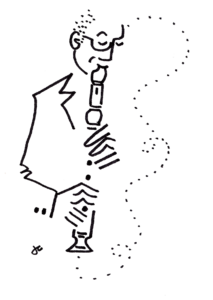 He now devotes his time to playing, writing, reviewing, publishing, composing and generally energising. He has played as recorder soloist with the Halle Orchestra, the Royal Liverpool Philharmonic Orchestra, the Manchester Camerata, and many other leading orchestras and ensembles.
Concertos and works with orchestra have been written for him by Gordon Crosse, Anthony Gilbert, Peter Hope, Kenneth Leighton, Elis Pehkonen, Alan Bullard, Ian Parrott, John Casken, and many other distinguished composers. His recordings include no less than five sets of the Brandenburg Concertos, as well as the F Major version of Brandenburg Concerto No. 4 with Menuhin and George Malcolm, but lately he has made numerous acclaimed recordings of the recorder’s contemporary concerto and chamber music repertoire, including four solo concerto discs, all of which have received critical acclaim.
The most recent (on the Divine Art label) are a recording of music by the novelist and composer (and fellow Mancunian) Anthony Burgess, a disc in memory of Alfred Deller (a good friend) with James Bowman and Robin Blaze, including music by Blow, Handel, Tippett and Fricker, and CDs of music by Roy Heaton Smith, Peter Hope and Jim Parker. In the last few years he has played in Germany, Switzerland, Poland, France, New Zealand, Japan and the USA, and given many recitals on Radio 3 with pianist Peter Lawson.
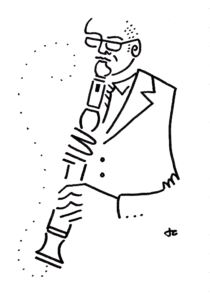 In all, he has given the first performances of over 600 works for the recorder, including works by many non-British composers, including Leonard Bernstein, Ned Rorem, Peter Sculthorpe, Douglas Lilburn, Petr Eben and Ruth Zechlin. Many of the works he has premiered have now entered the standard repertoire, and these and his own recorder compositions are regularly set for festivals and examinations.
Two new works recently published are Three Salutes and A Short Sprint, the latter for the young Japanese recorder player Hidehiro Nakamura. He edits series of recorder publications for both Forsyths and Peacock Press, and founded the periodical Manchester Sounds, in response to the perceived threat to music libraries in Great Britain. In addition he was responsible for the rediscovery of several works for his instrument, including the Rawsthorne Recorder Suite, Antony Hopkins’ Pastiche Suite, the Handel F Major Trio Sonata and John Parry’s Nightingale Rondo (the only substantial known British nineteenth century work for a fipple flute).
He has also discovered unknown or lost works by Alan Rawsthorne (the Chamber Cantata), C. W Orr (violin solos) and Gordon Jacob (an early anthem).
He was awarded an Honorary Fellowship by the Royal Northern College of Music in 2002 for his services to British music, and is a Visiting Distinguished Scholar of Manchester University.
John has been responsible for establishing, and is a trustee of, several charitable trusts which encourage the flourishing of music in his home area of Manchester and it’s environs, viz. the Ida Carroll Trust, the Rawsthorne Trust, the William Alwyn Foundation, the Douglas Steele Foundation, the Golland Trust and the Pitfield Trust.
These trusts enable many interesting concerts and recordings to take place, often by local artists, which would not otherwise happen and provide for awards and events at Chethams School, Stockport Grammar School, the Royal Northern College of Music, and elsewhere.
He has also established a concert series at St. Paul’s Church in his home town of Stockport, to which entry is free, with donations to the church.
HANDEL SONATA FOR TWO RECORDERS AND CONTINUO
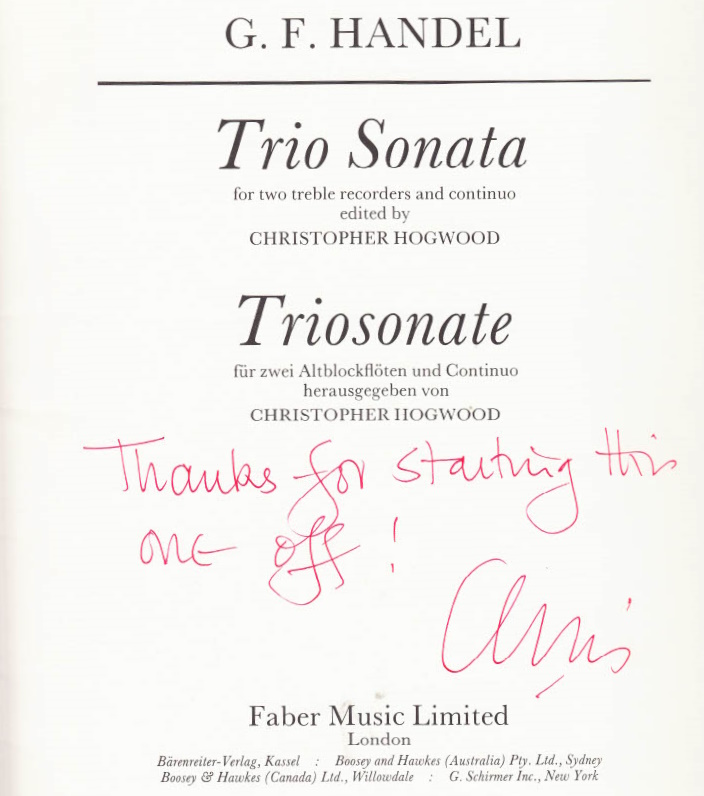
My contemporaries at Cambridge included the late Christopher Hogwood, whose digs were just round the corner, on Fitzwilliam Street, from my College, Fitzwilliam, which itself was just along Trumpington Street from Pembroke College, where Chris Hogwood was studying. He was frequently to be seen in the window, practising his harpsichord. I got to know him and David Munrow (also at Pembroke) well, and we played in many concerts together, including recitals for Pembroke’s musical Dean, Meredith Dewey. Several years later, after David’s tragic suicide, Chris was asked by the BBC to record, I think for Composer of the Week, a programme of trio sonatas, and asked me what I would like to play. I recalled that Schotts had published in 1948, in their “Recorder Library” a “Duo in F Major” for “Two Trebles with alternative setting in C Major for Two Descants”., by Handel. The work was stated to be “Arranged and Edited by Thurston Dart.” His editorial note reads as follows: “Among the vast collection of Handel MSS in the Fitzwilliam Museum, Cambridge, is the autograph of this isolated movement for two treble recorders. It has not been published before and the Syndics of the Museum have kindly given permission for it to be printed. All phrasings, breathmarks and ornaments are the suggestions of the transcriber and editor. The original MS contains none.”
I also showed Chris another Schott publication, dating from 1952, in their Recorder Library Series, of “Grave and Allegro for Two Trebles and Piano.” This too was edited by Dart, and his note is as follows: “These two movements from Fitzwilliam Museum MS 30 H11 are all that has survived of a Sonata Handel wrote in Italy while he was still a young man; they have not been published before and this first edition is made with the kind permission of the Museum Syndicate. The keyboard reproduces the original text of the recorder parts and the (unfigured) bass, though the obsolete notation of the bass in the second movement has been modernised.” Again the work was “Edited and Arranged by Thurston Dart”, I showed these to Chris at his house, thinking they might be appropriate for the recording, and he recalled that the late Charles Cudworth, the University’s distinguished and extremely erudite Music Librarian, had given to him a copy of a manuscript in the Library of Congress Washington DC (M359 M3 Case), which contained 3 volumes of eighteenth century trio sonatas, bound together. The manuscript included this Sonata, there attributed to Handel, but minus the “flauto primo” part. So the two sources fitted together like a glove to provide the complete sonata, of which myself, David Pugsley and Chris gave the first modern performance on the Third Programme (or it could have been the Home Service – not now sure which!). The work has of course since become a widely known and much loved part of the recorder’s standard repertoire. It was first published by Faber Music in 1981. The copy of that publication that Chris gave me (see attached) is inscribed “Thanks for starting this one off! Chris”. So though I kicked it off, fortuitously, we have also to thank Chris Hogwood, Bob Dart, Charles Cudworth, and the BBC, for their unwitting but crucial parts in this story of discovery.
John Turner
July 2024
A QUESTION OF BALANCE
Music has always been a huge part of my life. My mother was the pianist to a local semi-professional concert party, and her father, who died before I was born, ran a bus service between Gohati and Shillong in Assam, India, and was the organist of the Anglican church in Shillong. I still remember, as a toddler put to bed early, creeping to the top of the stairs to hear the rollicking sounds emanating from the small choir, accompanied by my mother. Occasionally I crept under the piano and relished the booming sounds coming from above.
My father wanted me to play the flute, because a close neighbour, who played the flute and subsequently became a distinguished eye surgeon, used to come round to the house to play Bach flute sonatas with my mother. During my first year in the Senior School at Stockport Grammar School, my father realised that the pair of roller skates he had bought for me were a complete waste of money, as I could not stay upright on them for more than a few seconds (balance problems!), and invested the proceeds in a second-hand flute. At about the same time I joined the school recorder group, run by the Latin Master, Donald (Bingo) Roberts, and remember those sessions with great affection. The music we played was very varied, two of my very favourites being the Davy Crockett song, and the Swedish Rhapsody. I still remember the tunes. I was also introduced to Britten’s Alpine Suite, the Hindemith Trio, the Fricker Suite, and the Gordon Jacob Suite for recorder and piano (later a great favourite of Michala Petri). Then my eyes were well and truly opened to twentieth century music, and I remember being initially perplexed, and then entranced, by the strange language of the Stanley Bate Sonatina – one of that Manuel Jacobs clutch of pieces published by Schotts.
There were two music masters at my school. The director of music was Geoffrey Verney, an erstwhile neighbour of Vaughan Williams in Dorking, whose pride and joy was the school choir, which he directed with finesse and aplomb. Being a shy little boy, singing did not appeal, and consequently I never studied GCE music. His second in command was Douglas Steele, a brilliant musician and sub-organist to Allan Wicks at Manchester Cathedral, likeable and extremely eccentric, and one of the founding fathers of Chethams School in Manchester as a specialist music school. Douglas had studied conducting as a pupil of Bruno Walter in Salzburg, and on his return to England became assistant to Sir Thomas Beecham at Covent Garden, about which period in his life he wrote entertainingly. A few of us recorder players used to go round to the music department after school to listen to and be regaled by a wide selection of music, from pop songs to the Janacek Sinfonietta! Douglas subsequently wrote several pieces for me, including Four Cornish Dances for solo recorder, Song for recorder and piano, High Noon for recorder and piano (a medley of memorable tunes), and ultimately a splendid and virtuosic Sonata for flute and piano, way beyond my flautistic abilities at that time! He also taught (at Chethams) the superlative pianist Sir Stephen Hough, who also adored him! Several of Douglas’s very memorable songs have recently appeared in the Associated Board examination lists, which would have given him great delight.
When I went up to Cambridge to read law (my father would much have preferred me to follow him into chemistry, but I demurred!) I was at a college (or rather the non-collegiate body, Fitzwiilliam House) with little in the way of a musical tradition at the time, though things have greatly altered since then. My two main college musical friends from the early days were the conductor and founder of the London Sinfonietta David Atherton and the composer and horn player Nicholas Marshall, a pupil of Lennox Berkeley, whose music I have always adored. Nicky has written me countless recorder works over the years, the outstanding ones being a Sonata with piano, a Concerto with string quartet, and two large song cycles with recorder obligato, The Falling of the Leaves and The Birds.
But just round the corner from Fitzwilliam House (before it attained collegiate status) were the lodgings of Christopher Hogwood, studying classics at Pembroke College, and I was intrigued by hearing the sounds of a harpsichord emanating therefrom. My first concert in Cambridge was performing the Frank Martin Sonata da Chiesa for flute and organ with Chris in the Round Church, and I have always retained a fondness for the music of Frank Martin. Through Chris came the introduction to David Munrow, who was reading English at Pembroke College, but played with his characterful effervescence both the bassoon and the recorder. David used to say that there was a better bassoonist than him at the University (Alastair Chisholm), so he was determined instead to be the best recorder player around, and he certainly was that (even though he could never double-tongue!). I recall many a happy afternoon playing Telemann and Mathieson duets at breakneck speed in his digs close by Pembroke College, with the windows flung wide open. It was one of his ambitions to set up a recorder consort, and he chose me to be a part of it because, like himself, I played another instrument as well as the recorder. David took the view that if you played another wind instrument you were likely to be a better recorder player than most (no longer true I think!). I recall very many happy concerts with both David and Chris. Other contemporaries were Andrew Davis, John Eliot Gardiner, Chris van Kampen, Tony Pay, Sebastian Forbes, Robin Holloway (who said he disliked the recorder but nonetheless wrote me a beautiful piece for Howard Ferguson’s eightieth birthday!), Jeremy Polmear…. The list is endless!
I had a very happy four years at university, and balanced, I hope fairly successfully, the law and the music. Then I had to choose between an academic career (I had received informal approaches from two universities for a lectureship) and being a practical lawyer. But the decision was really made for me, as I wanted to qualify as a solicitor and take the Law Society’s final examination. The firm who had offered me articles immediately took me into partnership when the articles expired, and I guessed that would be the end of my adventures in music. But I had a very sympathetic senior partner, who very much encouraged my musical activities, and in any event my legal work over the years involved acting for many musical organisations, including the Royal Northern College of Music, the Halle Orchestra, the National Youth Orchestra, and the Northern Chamber Orchestra, as well as many composers and performing musicians. It also involved setting up, usually pro bono, various charitable trusts to assist musicians and support the music of various composers.
One day, shortly after qualifying, I received a telephone call from David Munrow, who had been invited to perform in The Maltings as part of the Aldeburgh Festival, asking me to play in Britten’s Alpine Suite, which I had known and loved since my schooldays, as well as a new Occasional Suite, scored for three recorders, three clarinets, harpsichord and Strings by John Gardner (its first and last performance!) David said if I wanted to take part I would have to join the MU PDQ, which I promptly did. The concert itself, in the year before the huge fire at The Maltings, was exciting but terrifying, and I still remember my legs trembling uncontrollably. Nothing since has been quite so scary, though Brandenburg 4 at The Proms with the Neville Marriner and The Academy of St. Martins, shortly after, came a close second. Britten was complimentary and delightful, though he seemed more intrigued by a coaster unloading in the River Alde just onside the window of the rehearsal room! I recall that he promised David a piece for his Early Music Consort, though sadly it never transpired. Over the next few years, I played with David on many occasions in recitals, recordings, TV programmes, film scores et al. playing, as well as recorder, crumhorn, racket, rauschpfeife, gemshorn, panpipes (I was hardly a virtuoso on that), etc. His suicide in 1976 was a huge blow to all his friends and colleagues, and as executor I helped to deal with his estate. I owe to David and his widow Gill, a huge debt of gratitude, not only for the music, but for personal hospitality at their homes in St. Albans and Chesham Bois (where they were near neighbours of Edgar Hunt, also a friend).
When David died I expected the music to come to an end, but in fact it continued at a quicker rate than before as I had acquired so many contacts then in the musical world. My sublimely tolerant senior partner did not mind my frequent trips to Europe, as well as domestic dates, and even acquiesced in a long tour of the States with the Deller Consort, with whom I had given many recitals.
Eventually I decided that music as my first love must prevail, so I turned down the possibility of becoming senior partner in the firm. This would have entailed considerably more administrative work, and so I had the time to be more proactive as a musician, organising concerts, planning recordings, writing occasional scraps of music (I am very much a Sunday afternoon composer!) and generally making new things happen., as well as playing the recorder.
Apart from the baroque (particularly Bach, Handel, Purcell and Telemann), my particular love has been the music of my British contemporaries. Many composers have had strong connections with my home area, and I have relished new recorder works from Arnold Cooke, Thomas Pitfield, Anthony Gilbert, David Ellis, John Gardner, Gordon Crosse, Arthur Butterworth, Peter Hope, Edward Gregson, John Golland, John Manduell and many others. And I treasure music written for me by so many composers. Prominent amongst them are Kenneth Leighton, Robin Orr, Peter Fricker, Howard Ferguson, Stephen Dodgson, William Alwyn, Elis Pehkonen, Michael Berkeley, Peter Dickinson, Wilfrid Mellers, Howard Blake and a host of others, both famous and obscure. And I have been privileged to premiere recorder music by several foreign composers including Leonard Bernstein, Petr Eben, Douglas Lilburn, Peter Sculthorpe, Fulvio Caldini and Naji Hakim. Hopefully there is a treasure trove for recorder players of the future to relish and enjoy. Nothing would give me greater pleasure!
John Turner, August 2022
